Shower Chair Non-Slip Feet: TPR vs Rubber on Wet Tile
Soft feet are not non-slip feet. How TPR and rubber shower chair pads behave on wet tile and grout, what chlorine does, and what to write in the spec.
What this note covers
Soft feet are not non-slip feet. How TPR and rubber shower chair pads behave on wet tile and grout, what chlorine does, and what to write in the spec.
Covers: shower chair non-slip feet · shower chair foot pads replacement · bath chair rubber tips · TPR foot pads shower chair · shower chair replacement feet · bath safety chair spare parts
Key figures at a glance
A shower chair does not slip because its feet are soft. It slips because water has nowhere to go underneath the pad, because the pad has hardened after a year of bleach, or because the pad is small enough to drop into a grout joint and let a four-legged frame rock. Distributors write “non-slip feet” on the specification sheet and receive a soft rubber cap; the cap is not the mechanism. Geometry, compound and attachment are the mechanism, and all three are decided long before the chair reaches a bathroom.
This matters commercially because the floor-contact part is the cheapest component on the chair and one of the two that wear first — the other being the height-adjustment mechanism. Every shower chair in our range carries a pad that can be replaced on its own, and every one of them will need it eventually. A distributor who treats the pad as an accessory rather than a service part ends up retiring intact frames over a part that costs almost nothing to make and almost nothing to ship.
Geometry moves the water; softness does not
Put a flat pad on a wet glazed tile and the load pushes a film of water out to the edges but cannot squeeze it out from the centre. The pad is now sitting on water, and the friction you feel in your hand at the factory is irrelevant. The fix is not a softer compound, it is a path for the water: ribs, a cross channel, a ring groove, or a recessed centre that lets the loaded area make contact while the displaced water escapes sideways.
That single detail explains why two pads with the same hardness test very differently in a shower. It also explains why the cup design is more complicated than it looks. A deep suction cup does hold well on smooth porcelain, but on textured anti-slip tile and over grout lines it cannot seal, so it behaves like a flat disc while still trapping a pool of water in the middle of the pad. Trapped water in a warm wet room is also where biofilm starts, and a pad that has to be scrubbed out with a brush is a pad that will be replaced early.
So the first question on a quotation is not “what material” but “what is on the underside”. A drawing or a close-up photograph of the underside answers more than a page of compound description.
TPR versus rubber, judged on a wet floor
The two compounds in this category are thermoplastic rubber, usually written TPR, and vulcanised rubber. They are not interchangeable, and the difference that matters in a bathroom is not grip in the dry state.
TPR is a thermoplastic elastomer, commonly a styrenic block copolymer blend. Its commercial advantage is that it injection moulds, which means a ribbed, channelled or ringed underside costs almost nothing extra to produce and comes out identical part after part. It can be pigmented to match a frame, it can be supplied in a non-marking grade for care homes with vinyl flooring, and it resists hypochlorite better than natural rubber because it has fewer unsaturated double bonds for the chlorine to attack. Its weaknesses are honest ones: it swells in some oils and solvents, and a thin TPR pad under a heavy static load for years will take a compression set.
Vulcanised rubber is denser, more abrasion resistant and has higher hysteresis, which means it conforms to the micro-texture of a tile rather than sitting on top of it. That is a genuine advantage on rough or worn floors. The cost is in tooling: complex internal cavities are expensive in rubber, so rubber pads tend to be simpler shapes, usually flat with a chamfer. Natural rubber also ages harder and faster under repeated chlorine exposure, and the hardening is invisible — the pad still looks black and intact while it has turned into a puck that slides.
In our own range the split follows the application rather than a price tier. The wide heavy-duty YMX5109-S uses thickened TPR pads because the chair is rated to 350 kg and the pad has to stay conformable under a load that no rubber cap of that thickness would survive without deforming. The folding LM5206K and the YMX5208-S both use TPR foot mats on stainless frames rated to 150 kg. The wood-grain LM3200 uses sloped rubber pads, which is the right call for that chair because its legs splay outward and a sloped pad has to meet the floor square rather than at an angle — a shape that is easier to hold in rubber than to mould thin in TPR. The same logic runs into the cane category: the LM4904 carries tyre-grade TPR tips and three interchangeable bases, single foot, small quad and large quad, which is the clearest example on the site of a floor-contact part designed to be changed by the user.
And EVA is not a floor material. On the LM3200 it is the removable seat and back pad with drainage holes — closed-cell foam, soft, warm to sit on, quick to dry. Buyers occasionally ask for EVA feet because it is cheap and feels soft in the hand. Under a loaded leg it compresses, takes a permanent set, and the chair starts to sit unevenly within a season. Seat padding and floor contact are two different engineering problems that happen to share a word.
Grout lines, textured tile and what four pads actually carry
A shower chair is a four-point load case, and the arithmetic is worth doing once. At the 350 kg rating of the YMX5109-S, each of the four pads carries roughly 88 kg static. At the 150 kg rating of the LM5206K and YMX5208-S it is about 37 kg per pad. Static is the easy number; the load spikes when a user sits down rather than lowers themselves, and it is the spike that walks a loose pad off a leg.
Pad diameter then interacts with the floor. Grout joints in a tiled shower are typically a few millimetres wide and deep, and a small-diameter pad can drop into one, which tilts the leg and makes the whole chair rock. The user reads that as a loose chair and reports a manufacturing fault. The tighter fix is a pad wide enough to bridge the joint, plus a leg that is splayed enough to keep the load inside the footprint. This is also why pad replacement is model-specific and not a generic consumable: the bore has to match the leg outside diameter, and the pad has to sit square on a leg that may be angled.
Textured anti-slip tile creates the opposite problem. The texture is designed to catch a bare foot, and it will also abrade a soft pad from below. A pad with a hard skin and a softer core handles that better than a uniformly soft one, which is one more reason the compound question cannot be answered by hardness alone.
What a year of institutional cleaning does
A private bathroom is cleaned once a day at most. A care home bathroom is cleaned several times a day, often with a hypochlorite-based product at whatever dilution the operative mixed, plus a quaternary ammonium disinfectant on the same floor. That regime is the real service environment for a large share of the chairs a distributor sells, and it changes the failure mode completely.
The pad does not wear through. It glazes. The surface oxidises, the ribs round off, the compound hardens, and one day the chair that has been in service for fourteen months slides when a user puts weight on the front edge while standing up. Nothing on the pad looks broken, which is why this failure is under-reported in returns data and over-represented in incident reports.
Two practical consequences follow. First, the wear part should be excluded from the warranty in writing and priced as a part — a pad consumed in normal service is not a defect, and a supplier who quietly covers it is pricing that risk into every unit. Second, the compound should be checked against the actual cleaner. A one-week soak in the dilution printed on the label of the product your customer uses tells you more than any datasheet claim about chemical resistance, and it costs one pad and seven days.
The pad is the part: replacement economics
Four pads per chair, one per leg. That is the entire bill of materials for the most common field failure in the category, and it is why the parts conversation belongs in the first purchase order rather than the first claim.
Run the arithmetic on a single failure. A bag of four pads rides inside the master carton, adds a negligible amount of cube to a container that holds roughly 76 m³ in a 40HQ, and resolves the complaint in a phone call. A warranty return means booking freight from Europe or North America back to South China, a customs entry in both directions, and a frame that is written off on arrival because the return freight exceeds its value. The same failure costs one of those two numbers, and the difference is decided by whether someone put a part number on the model.
The spare parts and warranty programme covers the contract side of this in more detail, including how to size a kit from the parts that physically exist per unit rather than from a guessed percentage. The short version for shower chairs: four pads, one seat board, one backrest pad where the model has one, two armrest pads, and the height-adjustment pins. Those are the parts that fail. Everything else on the chair outlives the warranty by years.
What to write in the specification
Seven lines turn a vague non-slip requirement into something a factory can be held to.
- Compound and grade, named: TPR, or vulcanised rubber, plus whether a non-marking grade is required for vinyl or LVT flooring in care homes. Black marks on a light vinyl floor is a complaint that gets a whole product line removed from a catalogue.
- Underside profile: ribbed, channelled, ring-grooved or flat, with a drawing or underside photograph attached to the PO.
- Pad diameter and thickness, not just “standard”. This is what decides whether the pad bridges a grout joint.
- Attachment method and the leg outside diameter it fits: screw-in with a captured washer, push-in friction, or moulded over the tube end. Push-in is the cheapest and the one that generates claims.
- Hardness in Shore A, as a secondary check. Ask for the figure and treat anything hard enough to click on tile at room temperature as a warning, but do not buy on hardness — geometry dominates.
- A part number per model, so a reorder in two years does not depend on someone recognising a photograph.
- The load the pad was tested at on the assembled chair, not the load the compound can theoretically survive in a press.
How to test a pad before you commit a container
Testing a foot pad does not need a laboratory. It needs a wet tiled floor and an afternoon.
Sit and stand ten times on a wet tile with the chair loaded to its rating and watch the front pads. If the pad creeps forward under the leg, the attachment or the underside profile is wrong, and no compound change will fix it. Then push the chair sideways with a foot while it is loaded: a pad that skates is a pad that will be reported as a slip. Then soak one pad for a week in the disinfectant your market actually uses, dry it, and repeat the sit-stand test — the difference between the soaked pad and a new one is the number that predicts your replacement volume.
The commercial structure makes this cheap to do properly. Our minimum is $2,000 of order value with models mixed, production runs dispatch 7–10 days after deposit, and stock models dispatch in 3–5 working days, so a distributor can put two or three bathroom configurations into one order and find out which pad specification survives a real cleaning regime. The ordering terms that apply to every model are set out on MOQ and pricing, and the certificates a tender will ask for, including ISO 13485 8623138319 and ISO 9001 8629985173, are on certifications.
The judgement framework
Three questions decide whether a shower chair foot will still be doing its job in two years.
Does water have a path out from under the pad? If the answer is a flat disc, the answer is no, and the chair is relying on compound softness to compensate for a drainage problem.
Does the pad still grip after a month of the cleaner your customer actually uses? If nobody has soaked one, nobody knows, and the failure will surface as an incident rather than a return.
And can you buy the pad by part number, on its own, a year from now? If the answer is no, then every worn pad in your territory is a chair you have to write off, and the cheapest component on the product has become the most expensive one in the relationship.
A non-slip foot is not a material claim. It is a geometry decision, a compound decision and a service-part decision, and all three are settled at the quotation stage by a buyer who asks for the underside drawing instead of the word.
Frequently asked questions
- Should shower chair feet be rubber or TPR?
- For a wet room, TPR is usually the better starting point, not because it grips better in the abstract but because it can be injection moulded into a ribbed or channelled underside at low cost. That geometry is what lets water escape from under the pad. Vulcanised rubber is denser and more abrasion resistant, which matters on rough concrete but not on tile, and natural rubber hardens faster under repeated hypochlorite cleaning. Ask which compound is used and look at the underside profile, not the word on the datasheet.
- Why do the foot pads on my shower chairs keep falling off?
- Almost always the attachment, not the compound. A push-in friction pad relies on the leg outside diameter matching the pad bore within a tolerance, and it will walk off in transit or after a few months of sideways loading. A screw-in pad with a captured washer, or a pad moulded over the tube end, does not. If the pads arrive loose in the carton and the leg bore is not stated on the spec, expect a claim.
- How often should shower chair foot pads be replaced?
- Judge by the pad, not by the calendar. Replace when the underside has glazed smooth, when the ribs have worn flat, when the pad has taken a permanent set and no longer sits flat on tile, or when it has hardened enough that it clicks on the floor instead of conforming. In an institutional setting with daily hypochlorite mopping that can be well inside the 12-month warranty period, which is why wear parts should be excluded from warranty and priced separately.
- Can I replace shower chair foot pads without replacing the chair?
- On every shower chair in our range, yes: the pad is a separate part and the frame does not have to be returned. That is the whole economic argument. A pad ships in a bag inside the master carton for almost nothing; a chair shipped back from Europe or North America costs more in freight than the frame is worth, which is why the practical answer to a failed pad is a part in the post, not a warranty return.
What to fix before you request a quote
A non-slip foot is a geometry decision and a service-part decision. Specify the underside profile, the attachment method and a part number, and a five-dollar pad stops writing off a two-hundred-dollar chair.
How to apply this to your order
- Ask for the underside profile and the pad diameter in the quotation, not just the words non-slip feet.
- Get the attachment method in writing: screw-in, push-in, or moulded over the leg, with the leg outside diameter stated.
- Put a pad part number against every model in your range and order a bag per model with the first container.
- Soak one pad in the disinfectant your customers actually use for a week before you approve the compound.
Models this note applies to
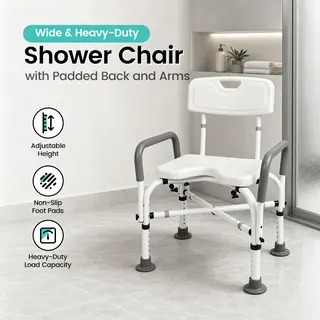
YMX5109-S
Wide heavy-duty shower chair with padded back and arms, 5-level height adjustment and a 350 kg load rating
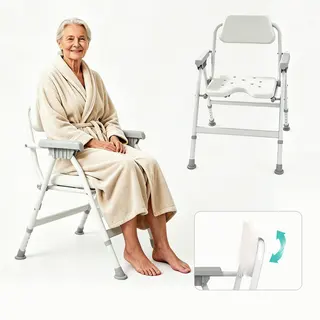
LM5206K
Folding shower chair with an adjustable backrest, 5-level height adjustment and a 150 kg load rating
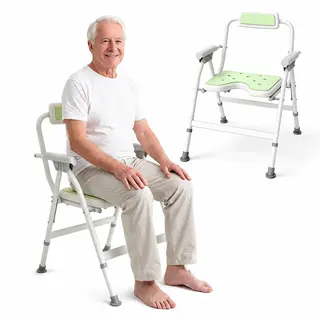
YMX5208-S
Folding bath chair with adjustable backrest, 5-level height adjustment and a 150 kg load rating
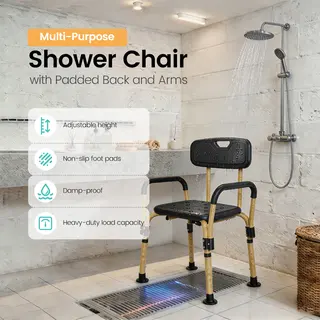
LM3200
Multi-purpose shower chair with a wood-grain finish, padded back and arms, tool-free height adjustment and a 150 kg load rating
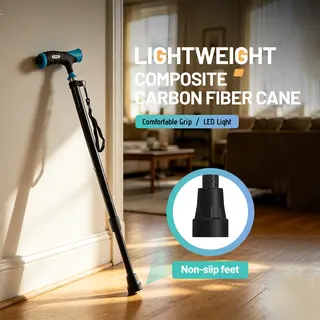
LM4904
Carbon fibre cane with a built-in LED light in the handle, dual-handle support and 10-level height adjustment
Related notes
Price this against your market
Send the category, the market and the quantity band. We reply with material options, MOQ per SKU, lead time and the certificates your market needs.